
Introduction
We are appreciative of universities volunteering to participate in the piloting for the Research Excellence Framework (REF Pakistan). This will give your university the opportunity to test yourselves as well as shaping the future of the REF which is intended to be introduced in Pakistan in 2026. Participation in the pilot will not in itself lead to a longer-term REF grading. The purpose is to test the design of the REF in Pakistan and help the Higher Education Commission (HEC) and the Steering Group evaluate what might need to be adjusted. It does however also give your university a ‘dry run’ which will enable you to make a stronger REF submission when the time comes.
What Does this Involve?
The pilot process runs from 20th January 2026 to 23rd February. Universities will need to complete the uploading process by 9th February. It is anticipated that some universities will do so earlier. The reviewer process will then complete over the remaining period. Universities will receive their results in early March. HEC and the project team will evaluate the results to present at the end of March 2026.
The REF Pakistan submission process requires universities to assemble a comprehensive, evidence-led portfolio demonstrating the quality, relevance, and contribution of their research. Each participating institution submits research classified into specific disciplinary categories, with sub-disciplines (specified in the Handbook). Each discipline submission is evaluated by an expert sub-panel, overseen by a main panel (A–D: life sciences, physical sciences, social sciences, arts/humanities Panel-E: Interdisciplinary & Cross-Cutting Research covers research that spans two or more main panels (A–D) organised around Pakistan’s national priority themes). The university prepares a structured package consisting of research outputs, an environment narrative and up to two impact case studies for each submission. There is accompanying evidence on evidence presentation in the REF Pakistan Integrated Handbook for universities (version 5.0 issued 19th December 2025). This provides clear guidance so that all universities provide information in a consistent and comparable manner.
It is anticipated that when fully implemented the final REF submission process will begin many months before the submission deadline, as institutions must identify which staff are eligible, which outputs should be submitted, and which impact cases show independently evidenced influence beyond academia. For the pilot this will be a much-shortened process but universities will need to designate a REF Pakistan Coordinator, who is familiar with data management, so most likely to be an existing ORIC or QEC co-ordinator. They will need to coordinate with colleagues to put together the qualitative evidence, the research impact, the case study etc. We refer to this as the support team. A vice chancellor or pro-vice chancellor may want to be nominal lead. HEC expect universities to choose the approach that best matches current internal processes.
Submission Procedure
Full guidance on the submission process and a set of three templates are available in the REF Pakistan Integrated Handbook. Once the pilot submission is finalised, it should be uploaded to the REF Pakistan pilot portal www.refpakistan.pk where it is checked for completeness and compliance.
Once the submission package is uploaded the institution will await the external assessment undertaken by independent reviewers. During this time, universities may be contacted to provide clarifications or supplementary evidence if required for audit or verification. After the review process concludes and scores are moderated, the institution receives its ratings for Outputs, Environment, and Impact. Clear documentation and evidence underpin the entire process, ensuring transparency, fairness, and credibility across all participating universities. In the final REF those results contribute to national benchmarks, funding decisions, and strategic analysis. For the pilot there will be an evaluation on the submission process, and universities will help shape any changes required.
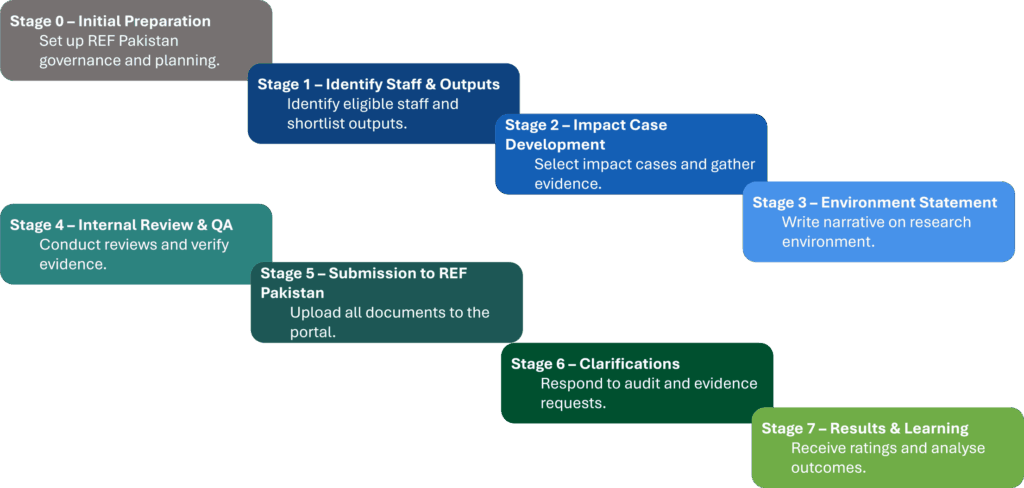
A Staged Approach
Universities must carefully select and justify the evidence underpinning each element of their REF Pakistan submission, drawing on both quantitative and qualitative sources. We are suggesting a staged approach.
Quantitative evidence may include citation data (where relevant), usage metrics, policy adoption figures, economic indicators, health or justice outcomes, or participation numbers demonstrating reach. Qualitative evidence, by contrast, often takes the form of policy documents, independent testimonials, legislative references, implementation records, media coverage, professional guidelines, or corroborating statements from external beneficiaries. A robust REF Pakistan submission will involve triangulation of both types of evidence to demonstrate not only that change occurred, but that the university’s research was a material and verifiable driver of that change. Institutions therefore invest some time in obtaining third-party documentation, securing permissions, and ensuring that the evidence meets REF Pakistan’s standards of independence, credibility, and traceability.
Deciding which impact case studies to submit is a major strategic task and varies depending on the size and disciplinary profile of each university so this may need to be started as early as possible. Institutions are permitted to submit up to two case studies per submission, with the number linked to headcount or institutional size thresholds set out in the REF Pakistan guidance. This restriction means universities must prioritise cases with the strongest, clearest, and most independently corroborated impact, supported by evidence that survives audit scrutiny. In the longer-term process universities may want to undertake multiple review cycles, assessing potential cases against star descriptors, evidence strength, degree of external influence, and alignment with national priorities. Only cases demonstrating sustained, significant, and well-evidenced impact then proceed to final submission. This internal calibration process can ensure that institutions present their most compelling examples of societal, economic, cultural, or policy impact and maximise Deciding which impact case studies to submit is a major strategic task and varies depending on the size and disciplinary profile of each university so this may need to be started as early as possible. Institutions are permitted to submit up to two case studies per submission, with the number linked to headcount or institutional size thresholds set out in the REF Pakistan guidance.
This restriction means universities must prioritise cases with the strongest, clearest, and most independently corroborated impact, supported by evidence that survives audit scrutiny. In the longer-term process universities may want to undertake multiple review cycles, assessing potential cases against star descriptors, evidence strength, degree of external influence, and alignment with national priorities. Only cases demonstrating sustained, significant, and well-evidenced impact then proceed to final submission. This internal calibration process can ensure that institutions present their most compelling examples of societal, economic, cultural, or policy impact and maximise their performance within the national review framework. For the pilot a more pragmatic approach may be required.
Category | Required? | Submitted As |
Output Context Summary | Yes | Word/PDF (≈150 words per output) |
Impact Case Study | Yes | Word/PDF (1,500–2,000 words) |
Environment Statement | Yes | Word/PDF + data tables |
Inclusivity Plan (not required for pilot) | Annex (PDF) | |
Responsible Metrics Annex | Yes | Annex (PDF/XLS) |
Authorship/Contribution Statement | Conditional | Upload per output |
Reproducible Data / Code | Conditional | Dataset link or file |
Peer Validation Evidence | Optional | PDF letters / citations |
ORIC Self-Assessment Data | Recommended | XLS/PDF |
EDI / Ethics Evidence | Integrated | Within templates |
Evidence Overview
Refer to handbook for full evidence requirements.
NB: The Inclusivity Plan is not required for the pilot as more work is required to define inclusivity for REF Pakistan.
Support
Support for any queries on the pilot process is available at [email protected]
University Submission Process: Full Step-by-Step
STAGE 0 — INITIAL PREPARATION
0.1 Interpret REF PAKISTAN Guidelines
Universities review:
- Handbook
- Document bundles for Outputs, Environment, Impact
- Evidence standards
- Eligibility criteria for staff and outputs
Purpose:
Ensure institutional understanding of expectations and compliance requirements.
0.2 Establish Institutional REF Pakistan Steering Group and support team
Includes:
- Appointed REF Pakistan Coordinator
- REF Pakistan academic lead
- Data/evidence officers
- Departmental coordinators
- Impact officers
- Administrative support
Purpose:
Centralise decision-making and workflow control.
STAGE 1 — IDENTIFY ELIGIBLE STAFF & OUTPUTS
1.1 Staff Identification
Institution compiles list of eligible academic staff based on national REF Pakistan definitions.
1.2 Output Mapping
Each department nominates:
- High-quality research outputs
- Outputs with the strongest evidence of contribution and rigour
- Supporting evidence (datasets, ethics, citations, peer review info)
Purpose:
Prepare a balanced, evidence-supported portfolio
STAGE 2 — IMPACT CASE STUDY DEVELOPMENT
2.1 Select Impact Cases
Choose cases with:
- Clear causal pathways
- Independently verifiable influence
- Strong stakeholder documentation
2.2 Collect Evidence
May include:
- Policy adoption documents
- Stakeholder letters
- Data on changes achieved
- Media coverage
- Programme evaluations
2.3 Draft and Refine Impact Narrative
Ensure:
- Clear outcome, not just activity
- Robust evidence chain
- Alignment to Annex 1 descriptors for reach and significance
STAGE 3 — ENVIRONMENT STATEMENT PREPARATION
3.1 Draft Environment Narrative
Must include:
- Strategy and governance
- Research culture
- Doctoral training
- Infrastructure
- Funding and grants
- KPIs and performance data
3.2 Evidence Assembly
- Organisational charts
- Policy documents
- Training logs
- Performance statistics
STAGE 4 — INTERNAL REVIEW & QUALITY ASSURANCE
4.1 Internal Peer Review
Multi-level review:
- Faculty committees
- University research office
- Impact and environment specialists
4.2 Evidence Verification
Check:
- Accuracy
- Authenticity
- Dates
- Independence
- Match to narrative claims
4.3 Final Adjustments
Refine narratives to:
- Match Annex 1 descriptors
- Remove overstated claims
- Strengthen evidence links
STAGE 5 — SUBMISSION TO REF PAKISTAN
5.1 Upload to Portal
University uploads:
- Outputs
- Impact case studies
- Environment statement
- All documentary evidence
- Staff and output metadata
5.2 Compliance Checks
System verifies:
- Completeness
- File naming
- Formatting
- Missing evidence
University may amend before deadline.
STAGE 6 — POST-SUBMISSION CLARIFICATION PERIOD
REF Pakistan Secretariat may request:
- Additional evidence
- Clarification on methodologies
- Verification of impact claims
- Confirmation of dates or personnel
Universities must respond promptly.
STAGE 7 — RESULTS AND LEARNING
7.1 Receive Scores
Institution receives:
- Output rating
- Environment rating
- Impact rating
- Panel feedback
7.2 Strategic Review
University analyses:
- Performance gaps
- Comparative position
- Strengths/weaknesses
7.3 Institutional Learning
Used to refine:
- Future research strategy
- Impact generation processes
- Research culture planning
- Readiness for REF Submission post launch
HEI Pilot Research Submission Guidelines
1. Access the REF Pakistan website
- Open an internet browser.
- Type refpakistan.pk into the address bar.
- Press Enter.
- You will be taken to the website dashboard (landing page).
2. Decide whether to Register or Login (from the dashboard)
On the dashboard landing page, you will see two options:
- Register (for new users who do not yet have an account)
- Login (for users who have already registered)
Proceed according to your status:
A. Registration (First-time users)
- Create your REF Pakistan Submission account
- On the dashboard (landing page), click Register.
- You will be directed to the registration page.
- Enter the required registration details exactly as requested on the page:
- Username
- First Name
- Last Name
- Email Address
- Password
- Submit the registration (as prompted by the page).
- Your REF Pakistan Submission account will be generated.
B. Login and account access (Registered users)
-
- Login to the platform
- Return to the dashboard (landing page).
- Click Login.
- Follow the Login process on-screen to access your account.
- Use the account menu option
Once logged in, you can:
- Click Account to access your account page, or
- Click Logout to log out of your account.
C. Managing your account details
-
- Update your registration information (if needed)
- From the post-login options, click Account.
- On the Account page, you may edit your registration information if your contact details have changed.
- Save/confirm changes as prompted on the page.
D. Navigating to submission areas
- Open the submissions area
- Locate the top-right button labelled ‘User’.
- Click ‘User’.
- You will be directed to the User page.
On the User page, you will see multiple buttons. These buttons take you to the different submission template pages where you provide your submission inputs.
5. Submitting required information via the User page buttons
5.1 Institution Profile submission
5.1.1 Open the Institution Profile page
- On the User page, click Institution Profile.
5.1.2 Enter the required Institution Details
On the Institution Profile page, submit the following (as specified in the template):
- Institution Name
- Sector
- Province of Location
- Institutional Type
- Primary Disciplinary Strengths
- Institution Size
- Total Number of Faculty Members (full-time equivalent)
- Total Number of PhD Faculty Members
- ORIC Information
- Research Profile
Complete the fields and submit/save as the page requires.
5.2 Environment Statement submission
5.2.1 Open the Environment Statement page
- On the User page, click Environment Statement.
5.2.2 Submit the Environment Statement content areas
On the Environment Statement page, submit content in the sections covering:
- Research Strategy and Context
- Research Culture and Support Environment
- Inclusivity Information
- Research Facilities and Infrastructure
- Research Integrity and Governance information
- Funding, Resources and Sustainability information
- Collaboration and External Engagement information
- Contribution to Capacity Building
- Supporting Evidence
- KPIs and Performance Data
5.2.3 Upload the required supporting files (separate uploads)
Also provide separate file uploads for:
- Organisational charts
- Policy documents
- Staff training logs
- Performance statistics
Complete the template fields and uploads, then submit/save as required by the page.
5.3 New Research Output submission (i.e., Context Statement)
5.3.1 Open the New Research Output page
- On the User page, click New Research Output.
5.3.2 Submit the New Research Output information areas
On the New Research Output page, submit the required information across the following areas:
- Core Identification submission information
- Authorship and Contribution information
- Research Context
- Impact-Linkage
- Integrity and Ethics Information
- National Alignment and Strategic Relevance
- Supplementary information, such as:
- Linked datasets
- Associated funding sources
- Knowledge Exchange and Commercialisation information
- Submission file upload
- Associated documents upload
Complete all relevant fields and upload items as required by the page.
5.3.3 View and manage your uploaded Research Outputs (Output List)
Within the New Research Output page:
- Click the top-right button labelled Research Outputs.
- You will be directed to your Output List page.
- A table will be displayed showing the New Research Outputs you have uploaded, including:
- Titles
- Output Types
- Publication Year
- Status (Draft/Finalised)
Use this page to review what you have uploaded and confirm the displayed status for each entry.
5.4 New Case Study submission
5.4.1 Open the New Case Study page
- On the User page, click New Case Study.
5.4.2 Submit the Case Study information areas
On the New Case Study page, submit:
- Title
- Case Study Narrative, including:
- Summary of Impact
- Underpinning Research
- Details of Impact
- Independent Verification upload
- Impact Category/Type
- Evidence document uploads
- Stakeholder documentation uploads
Complete all relevant fields and upload items as required by the page.
5.4.3 View and manage your uploaded Case Studies (Case Studies list)
Within the New Case Study page:
- Click the top-right button labelled Case Studies.
- You will be directed to your Case Studies page.
- A table will be displayed showing the New Case Studies you have uploaded, including:
- Titles
- Lead Author/PI
- Publication Year
- Status (Draft/Finalised)
Use this page to review what you have uploaded and confirm the displayed status for each entry.
6. Logging out (when finished)
- When you have completed your work, use the Logout option (available after login).
- Click Logout to log out of your account.